
One of the first things I tell my IEW students at the beginning of the year is “I am going to teach you to write, but I am also going to teach you to follow directions.” That may sound like two different goals, but in IEW they go hand in hand. IEW® Writing Companion supports students as they learn the importance of following directions.
IEW teaches writing with a checklist. Students are not simply told to write a good paragraph or make this sound better. They are given specific requirements, and students show they have followed these requirements by following a defined marking system.
Include dress-ups in every paragraph you write. Underline them.
Include a topic sentence and clincher sentence in each paragraph. Bold key words.
Vary sentence structure by using specific sentence openers. Number them.
The checklist with its specific requirements serves an important purpose. It makes writing objective rather than subjective. A teacher can look at a student’s paper and determine whether the required elements are actually there. The student knows what is expected, and the teacher has a clear basis for evaluation.
However, there is another benefit that is easy to overlook: Following the checklist teaches students to follow directions. That may just possibly be the most valuable benefit of all. After all, teaching students to follow directions is a life skill they will need long after writing class is over. IEW Writing Companion (Podcast Episode 542) turns this learning process into something almost like a game.
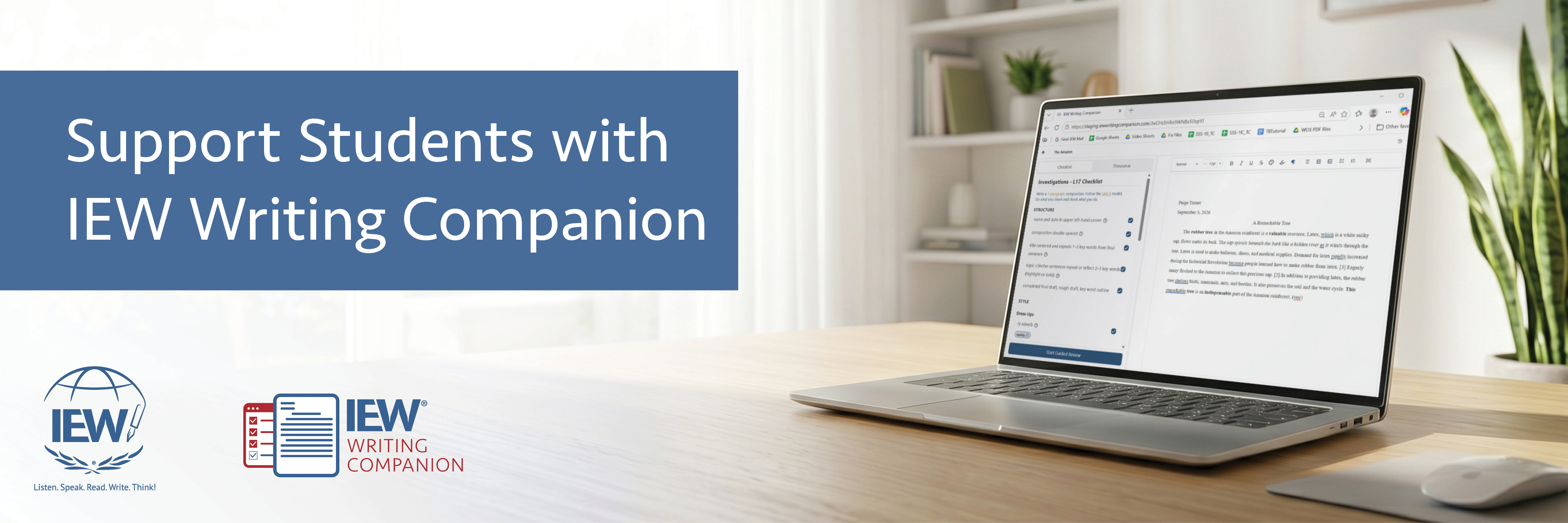
IEW Writing Companion is an online word processor designed specifically to support IEW student writers.
Instead of simply giving students a blank page, IEW Writing Companion includes the checklist that matches the assignment. As students complete their writing assignments, they have access to helpful reminders and word lists that support successful writing. They can click the question mark to be reminded of the comma rules. They can click the check box to show that they have reviewed that item.

An integrated thesaurus helps students find precise vocabulary to express their ideas effectively. After all, including a strong verb or -ly adverb is effective only if the chosen words fit the context of the sentence. They no longer have the excuse of not knowing where to find the thesaurus.

Before students can download, share, or print their work, the Guided Review requires them to check their compositions against the requirements. Students must identify elements on the checklist correctly. They highlight and select their name, date, title, and other requirements. In other words, IEW Writing Companion does not simply make the writing process easier. It makes students responsible for following directions. That distinction matters.

In the AI world, many digital tools are designed to find and fix mistakes for students. When the tool does the correcting, the student may never notice the mistake. They do not think about how to fix it. At IEW we train students to think. That is why we created a digital tool that supports students without taking that thinking away from them.
Over time, students who use IEW Writing Companion learn to slow down and pay attention to what the assignment requires. When something is missing or incorrectly marked, the student must stop, look at the directions, and determine what needs to be changed.
“Do what you check and check what you do.” This maxim of Andrew Pudewa is more than a reminder to mark a checklist. It is a habit of careful work.
Did you underline one -ly adverb in each paragraph?
Did you number the sentence openers?
Did you bold key words in the topic and clincher sentences?
Did you use key words from the final sentence to write a title?
These details may seem unnecessary to a student, but learning to slow down, follow directions, and check work are skills that extend far beyond an IEW writing assignment. Instead of waiting for a teacher to point out what they missed, students learn to take responsibility for their own work.
Over time, the checklist becomes more than a list of requirements. It becomes a habit of careful thinking and responsible work. While it is true that some students may initially be frustrated, that is okay because we are doing more than teaching students to write. As we teach students to follow directions and check their work, we are equipping them to become confident and competent communicators and thinkers.
by Heidi Thomas